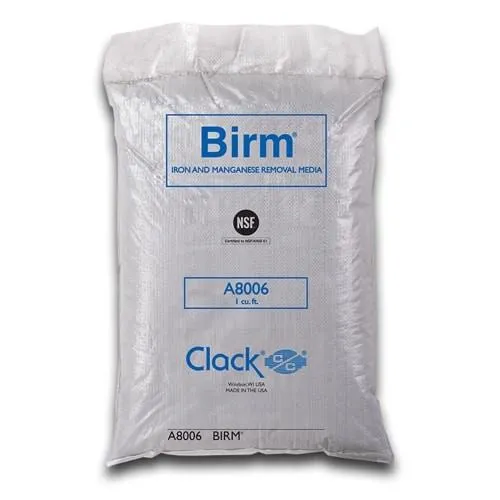
Birm is a granular filter media made by impregnating manganese salts into an aluminum-silicate core.
It is used primarily for removal of dissolved iron and manganese from raw water — common contaminants especially in well water.
Birm acts not by adsorption but as a catalyst: it accelerates the oxidation of soluble iron (Fe²⁺) by dissolved oxygen (O₂) in the water → this iron oxidizes to insoluble ferric hydroxide, which then precipitates and can be filtered out.
A key benefit: Birm itself is not consumed or “used up” during the process — so you don’t need chemical regeneration. Only occasional backwashing (rinsing) is required to remove the built-up precipitate.
🔧 Operating Conditions & Limitations
To work effectively, Birm requires certain water conditions:
pH: Water should typically fall in the range ~ 6.8 to 9.0.
Dissolved Oxygen (DO): There must be enough oxygen — at least ~ 15% of the iron concentration — in the water for oxidation to occur.
No incompatible substances: Birm should not be used if the water contains high chlorine, hydrogen sulfide, oil / hydrocarbon contamination, or other chemicals that impede its catalytic action.
Backwash requirement: Over time precipitated iron/manganese build-up must be flushed out by backwashing the filter bed — otherwise performance will decline.
Because of these constraints, for water with very low dissolved oxygen, high organic load, sulphide, or aggressive chemicals — Birm might not be the right choice. In such cases, other media or pre-treatment (e.g. aeration, oxidation) might be needed.
✅ Pros — Why Birm Is Widely Used
No chemical regeneration needed — only water backwash.
Good removal efficiency for iron and manganese under proper conditions.
Relatively inexpensive and low-maintenance compared to media requiring chemical regeneration.
Works in both gravity and pressurized systems — flexible use in household or industrial water filtration setups.
⚠️ When Birm Is Not A Good Choice / What to Watch Out For
If water lacks oxygen (low DO) — Birm cannot oxidize iron/manganese, so removal efficiency drops drastically.
If water contains chlorine, polyphosphates, oil, hydrogen sulfide or significant organics — these can impair Birm’s catalytic surface and reduce performance.
If you cannot regularly perform proper backwashing or maintain required bed depth / flow rates — filter will clog or lose effectiveness.
ADVANTAGES • Under the proper conditions, no chemicals to purchase for maintenance. Regenerant not required. • Iron removal efficiency is extremely high. • Negligible labor cost: only periodic backwashing required. • Durable material with a long life and wide temperature range. • Weighs only 36-38 lbs./cu. ft. PHYSICAL PROPERTIES • Color: Black • Bulk Density: 36-38 lbs./cu. ft. • Mesh Size: 12 x 50 • Specific Gravity: 2.0 gm/cc • Effective Size: 0.48 mm • Uniformity Coefficient: 2.7 CONDITIONS FOR OPERATION • Alkalinity should be greater than two times the combined sulfate and chloride concentration. • Temperature Range: 35-100oF • Water pH range: 6.8-9.0 • Dissolved Oxygen (D.O.) content must be equal to at least 15% of the iron and 29% of the manganese content. • Bed depth: 30-36 in. • Maximum Pressure Drop: 2-4 psi (14 -28 kPa) (∆ p increase from clean bed) • Freeboard: 50% of bed depth (min.) • Backwash rate: 10-12 gpm/sq. ft. • Rinse Rate: At service flow rate • Backwash Bed Expansion: 20-40% of bed depth (min.) • Service flow rate: 3.5-5 gpm/sq. ft. intermittent flow rates and/or favorable local conditions may allow higher flow rates INFLUENT AND BACKWASH LIMITATIONS • Free chlorine concentration less than 0.5 ppm • Hydrogen Sulfide should be removed prior to contact with Birm media • Oil: None Present • Polyphosphates: None present Birm® is an efficient and economical media for the reduction of dissolved iron and manganese compounds from raw water supplies. It may be used in either gravity fed or pressurized water treatment systems. Birm acts as an insoluble catalyst to enhance the reaction between dissolved oxygen (D.O.) and the iron compounds. In ground waters the dissolved iron is usually in the ferrous bicarbonate state due to the excess of free carbon dioxide and is not filterable. Birm, acting as a catalyst between the oxygen and the soluble iron compounds, enhances the oxidation reaction of Fe++ to Fe+++ and produces ferric hydroxide which precipitates and may be easily filtered. The physical characteristics of Birm provide an excellent filter media which is easily cleaned by backwashing to remove the precipitant. Birm is not consumed in the iron removal operation and therefore offers a tremendous economic advantage over many other iron removal methods. Other advantages of Birm include; long material life with relatively low attrition loss, a wide temperature performance range and extremely high removal efficiency. Negligible labor costs are involved because Birm does not require chemicals for regeneration, only periodic backwashing is required. When using Birm for iron removal, it is necessary that the water: contain no oil or hydrogen sulfide, organic matter not to exceed 4-5 ppm, the D.O. content equal at least 15% of the iron content with a pH of 6.8 or more. If the influent water has a pH of less that 6.8, neutralizing additives such as Clack Corosex®, Calcite or soda ash may be used prior to the Birm filter to raise the pH. A water having a low D.O. level may be pretreated by aeration. Untreated water should periodically be monitored for raw water parameters. Treated water should periodically be monitored for manganese and if present iron shortly before a regeneration and immediately after a regeneration to monitor how the filter system is functioning. Elevated treated water manganese concentrations before regeneration may mean that the filter media is being destroyed or bed reduction capacity has been exceeded. Take corrective actions as necessary. If chlorine and hydrogen sulfide are not present, low pH or lack of oxygen are the most likely conditions leading to media destruction. Additions of chemicals to influent or backwash water which contacts Birm media may inhibit iron or manganese removal or may break down or coat Birm media. Chlorination greatly reduces Birm’s activity. High concentrations of chlorine compounds may deplete the catalytic coating. Polyphosphates are known to coat Birm and reduce Birm’s ability to remove iron or manganese. Before adding any chemical to the influent or backwash water, the chemical's compatibility with Birm should be thoroughly tested. Clack Birm may also be used for manganese reduction with the same dependability as iron removal. In these applications the water to be treated should have a pH of 8.0-9.0 for best results. If the water also contains iron, the pH should be below 8.5. High pH conditions may cause the formulation of colloidal iron which is very difficult to filter out. All other conditions remain the same for either manganese or iron removal. • Organic Matter: Less than 5 ppm TOC

Свържете се с нас
Независимо дали имате въпроси, обратна връзка или нужда от помощ, нашият екип е тук, за да помогне. Просто попълнете формуляра по-долу.
Благодарим ви, че се свързахте с нас!